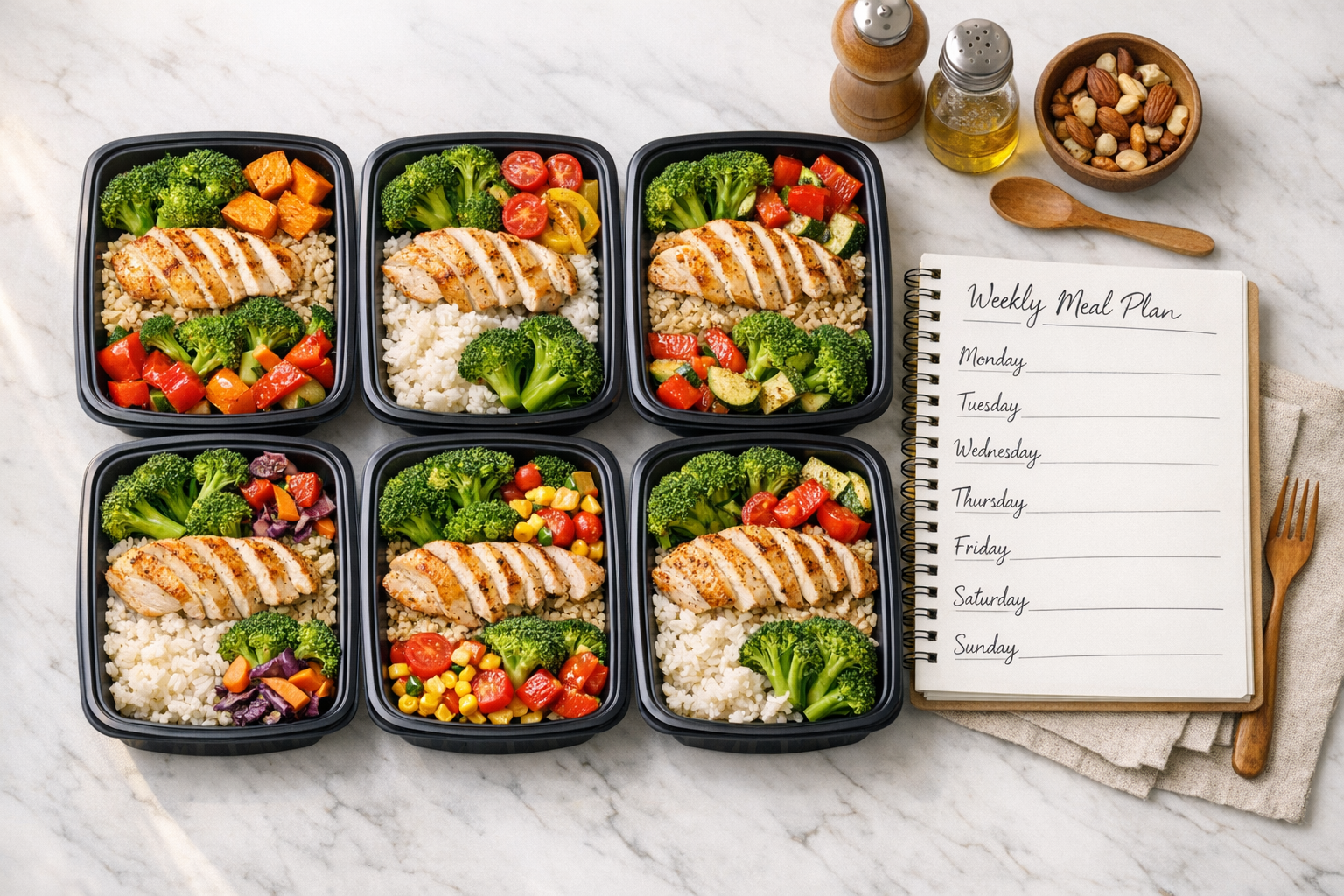
You want to eat better. Maybe lose weight, maybe build muscle, maybe just stop standing in front of the fridge every evening eating "whatever". The first piece of advice you read everywhere: "Create a meal plan." Sounds simple. It is. But most people make it more complicated than it needs to be. In this guide, I'll show you — Tobias Lobitz, founder of fytrr — how to create a meal plan that fits your daily life. Step by step. No nutrition science degree required.
Want to calculate your calorie needs right now?
Open the free calorie calculator →Why most meal plans fail
Before we start: let's talk about why meal plans don't work. Not the plans themselves — but how people execute them. From fytrr's user data, we see three patterns: First, too much variety from day one. Planning 7 different breakfasts, 7 lunches and 7 dinners means 21 meals per week — 21 recipes, 21 ingredient lists. Nobody keeps that up for more than a week. Second, unrealistic calorie targets. If you normally eat 2,400 kcal and create a 1,200 kcal plan, you'll give up after 3 days. A healthy deficit is 300–500 kcal — that's also what the WHO recommends. Third, no backup plan. Tuesday evening, long day, no energy to cook — without a simple backup meal planned, you order pizza. The solution to all three problems: plan less, but plan the right things.
The 3-3-1 method: meal planning that works
After analysing over 8,000 generated meal plans on fytrr, we identified a pattern among the most successful users. We call it the 3-3-1 method: 3 main meals per day that together hit your calorie target. 3 fixed dishes per meal slot that you rotate weekly. 1 backup meal that you always have at home. That gives you 9 dishes for the whole week plus an emergency option. Why it works: 9 dishes are manageable and fit on one shopping list. Repetition reduces decision fatigue — you don't have to think about what to eat every morning. And the backup meal catches bad days. Example: wholemeal bread with cream cheese and tinned tuna. No prep, 400 kcal, 35g protein. Always in the house.
Step 1: Set your goal
Your meal plan needs a goal. Not "eat healthier" — that's too vague. Pick one of three concrete goals: Weight loss (300–500 kcal below your daily needs, typically 8–16 weeks), muscle building (200–400 kcal above your daily needs, typically 12–24 weeks) or weight maintenance (meet your calorie needs, ongoing). If you want to lose weight: aim for 0.5 kg per week as a healthy pace. Faster is possible but not sustainable. At a 300–500 kcal daily deficit, you'll automatically land in this range. If you want to build muscle: you need a slight surplus — no more than 200–400 kcal. More gets stored mainly as fat.
Step 2: Calculate your calorie needs
Before you can plan meals, you need to know how many calories you need per day. Two factors determine this: your basal metabolic rate (BMR) — what your body burns at rest — and your activity factor. BMR × activity factor = daily needs (TDEE). Typical values: a 30-year-old woman, 65 kg with an office job needs about 1,960 kcal. A 30-year-old man, 80 kg with an office job about 2,520 kcal. With moderate activity, values rise to about 2,240 and 2,880 kcal respectively. Want a more precise number? Use our free calorie calculator — 30 seconds, no account needed. If you want to lose weight, subtract 300–500 kcal from your daily needs. That's your calorie target for the meal plan.
Step 3: Distribute your macronutrients
Calories alone aren't enough. What matters is where the calories come from. The three macronutrients serve different functions: Protein (25–30% of calories, 4 kcal/g) for muscle preservation and satiety. Carbohydrates (40–50%, 4 kcal/g) for energy and training. Fat (25–30%, 9 kcal/g) for hormones and vitamins. The most important number is protein: at least 1.6g per kilogram of body weight, whether losing weight or building muscle. At 75 kg, that's 120g protein per day. A concrete example: 75 kg, goal weight loss, 2,000 kcal/day — that gives you 150g protein, 200g carbs and 67g fat. 150g protein across 3 meals = 50g per meal. Doable: 200g chicken breast has about 46g protein, a tin of tuna 26g, 200g low-fat quark 24g.
Step 4: Build your meals
Now it gets concrete. Choose 3 dishes for each meal slot that you enjoy and that fit your calorie target. Three rules: every meal needs a protein source (eggs, yoghurt, chicken, fish, legumes, tofu). At least 2 of 3 dishes should be ready in under 15 minutes. And choose dishes you already know — now is not the time for culinary experiments. Example for a weight loss plan at about 1,800 kcal/day: Breakfast options like overnight oats with protein powder (420 kcal, 35g protein, 5 min), wholemeal bread with scrambled eggs (380 kcal, 22g protein, 8 min) or Greek yoghurt with granola (410 kcal, 28g protein, 3 min). Lunch like chicken breast with rice and broccoli (580 kcal, 48g protein) or tuna wrap with salad (520 kcal, 38g protein). Dinner like salmon with sweet potato (620 kcal, 42g protein) or large salad with chicken and feta (550 kcal, 40g protein). Plus a backup meal: wholemeal bread with cream cheese and tinned tuna.
Step 5: Write your shopping list and start
Take your 9 dishes and write down all the ingredients. Per week you need each ingredient in triple quantity, since you eat each dish 2–3 times per week. For the weight loss plan above you need: Fridge — 600g chicken breast, 200g salmon, 6 eggs, 500g Greek yoghurt, 250g low-fat quark, feta, cream cheese, avocado. Pantry — oats, wholemeal bread, rice, wholemeal wraps, red lentils, 2 tins of tuna, granola, optional protein powder. Fruit and vegetables — broccoli, sweet potato, tomatoes, lettuce, cucumber, bananas, berries. Estimated cost: 45–55 EUR per week, or 6–8 EUR per day for all meals.
Meal prep: The Sunday trick
You don't have to cook every day. With 90 minutes on Sunday, you prepare most of your week: cook rice, bake chicken breast in the oven (all 600g at once), chop vegetables and blanch broccoli, cook a lentil stew (one big batch for 3 meals), prepare overnight oats for 3 days, portion everything into containers. Result: 5–6 ready meals in the fridge. Lunch and dinner for Monday to Wednesday are done. From Thursday, cook fresh or repeat the prep for the second half of the week. fytrr users who use meal prep stick with their plan 2.3× longer on average than users who cook daily. The reason is simple: when the food is already in the fridge, there's no moment of decision.
What to do when the plan isn't working
You've created your plan, stuck with it for a week, and something's off. Before you throw everything out, check these three things: Constantly hungry? More protein and more volume. Replace a meal with a version that has more vegetables and more protein. Broccoli, courgette and cauliflower have almost no calories but fill the stomach. Weekdays work but weekends don't? Plan the weekend in — keep one fixed meal (e.g. breakfast), leave the rest flexible but keep a calorie target in mind. Bored after 2 weeks of the same food? Swap 2–3 dishes. Not all of them. Keep the structure (3-3-1), just swap the recipes.
Creating a meal plan yourself vs. letting an app do it
You can create your plan entirely yourself — this guide gives you everything you need. But there are alternatives: Creating it yourself is free, takes 2–3 hours initially, and you know yourself best. An app like fytrr costs 3.99 EUR/month, takes 5 minutes, and the AI adapts to your goal, budget and preferences. A nutritionist costs 80–150 EUR/hour, offers the highest personalisation, but requires appointments for adjustments. Honest assessment: for most people, an app or this guide is enough. You need a nutritionist if you have medical conditions like diabetes, kidney problems or eating disorders. In those cases, no app replaces professional advice.
7 mistakes that sabotage your meal plan
First: you drink your calories. A latte macchiato has 200 kcal, a glass of orange juice 110 kcal — three drinks a day and you've consumed 500 kcal without eating anything. Second: you underestimate portion sizes. For the first 2 weeks: use a kitchen scale. Third: you skip meals and then overeat in the evening. Fourth: you cook too elaborately — recipes with 15 ingredients are Sunday projects, not everyday meals. Fifth: you ignore what you actually like to eat. Sixth: you try to be perfect — 80% adherence is enough for results. Seventh: you never adjust the plan. Your body changes. If you've lost 5 kg, your calorie needs have dropped. Recalculate every 4–6 weeks.
What fytrr does differently
Most meal plan apps give you a PDF list of meals and that's it. fytrr works differently: AI-generated plans tailored to your goal, budget, preferences and intolerances. Swap meals with one tap — don't fancy salmon today? One tap, new meal, same calories and macros. Training and nutrition together, coordinated. Your meal plan takes into account whether you're training today or not. 3.99 EUR/month, no contract, cancel anytime.
Conclusion
Creating a meal plan doesn't have to be complicated. 5 steps: Set your goal. Calculate your calorie needs. Distribute your macros (protein first). Choose 9 dishes (3-3-1 method). Write your shopping list and get started. The perfect plan doesn't exist. The best plan is the one you actually follow through on. Start simple, observe what works, and adjust after 2–3 weeks.
Or let our AI create your meal plan with a matching workout.
Create your free workout and meal plan →